

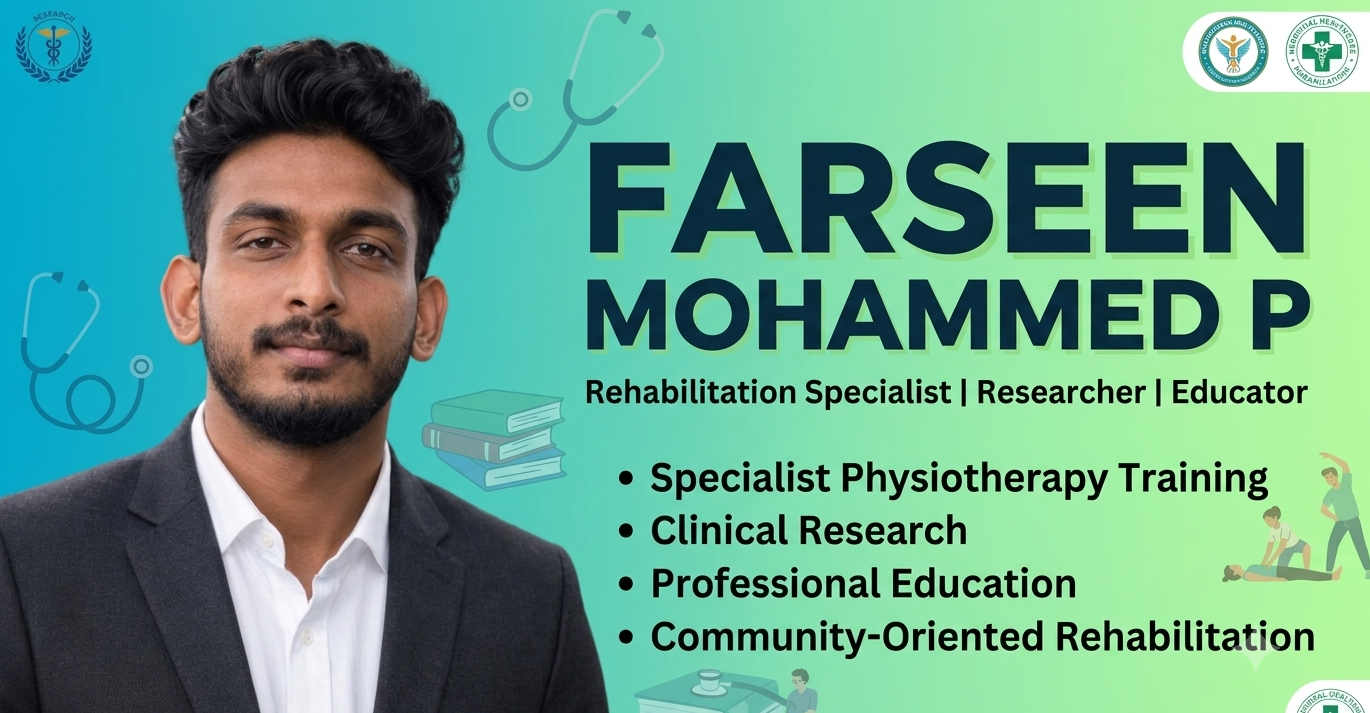
Mangaluru, Karnataka: Clinical exposure across different healthcare institutions can provide physiotherapy students and young professionals with opportunities to encounter varied patient populations, clinical environments and rehabilitation practices. Farseen Mohammed P, a specialist physiotherapist in neurosciences and clinical researcher, developed his clinical foundation through training and internships across multiple healthcare institutions in Kerala and Karnataka.
His clinical education has included experience in neurological, orthopaedic, musculoskeletal and other physiotherapy settings, contributing to the development of a broad professional perspective.
Clinical Training as a Foundation for Physiotherapy
Farseen completed his Bachelor of Physiotherapy at the Co-operative Institute of Health Sciences, Thalassery, affiliated with Kerala University of Health Sciences.
His undergraduate education included clinical training and internship experience at several hospitals and healthcare institutions.
He later pursued a Master of Physiotherapy in Neurosciences at Yenepoya Physiotherapy College, Yenepoya (Deemed to be University), Mangaluru.
Together, these experiences provided a progression from broad physiotherapy training toward specialization in neuroscience physiotherapy.
Undergraduate Clinical Exposure
During his undergraduate training and internship between 2022 and 2024, Farseen gained clinical exposure at institutions including:
- Co-operative Hospital, Thalassery
- Aster MIMS, Kottakkal
- Meitra Hospital, Calicut
- Bangalore Baptist Hospital, Hebbal
- Tirurangadi Taluk Hospital
- Baby Memorial Hospital, Calicut
The range of institutions provided exposure to different healthcare environments and patient populations.
Such experiences can help physiotherapy students develop familiarity with clinical assessment, rehabilitation planning and professional interaction within healthcare teams.
Experience Across Kerala and Karnataka
Farseen’s clinical training extended across two South Indian states.
His undergraduate clinical exposure included several institutions in Kerala as well as Bangalore Baptist Hospital in Karnataka.
His postgraduate education later took place in Mangaluru, Karnataka, at Yenepoya Physiotherapy College and Yenepoya Medical College Hospital.
This geographic spread forms an important part of his early professional development.
Postgraduate Training at Yenepoya
Farseen’s postgraduate clinical training at Yenepoya Medical College Hospital, Mangaluru, from 2024 to 2026 provided more focused exposure to neuroscience physiotherapy and rehabilitation.
His clinical training included neurological conditions such as:
- Stroke
- Parkinson’s disease
- Traumatic brain injury
- Guillain–Barré syndrome
- Spinal cord disorders
This experience supported his specialization in neurophysiotherapy and neurorehabilitation.
Development of Neuroscience Expertise
The postgraduate clinical experience at Yenepoya helped Farseen move from general physiotherapy training toward a more specialized neuroscience-oriented professional profile.
His clinical education included exposure to approaches such as:
- Neurodevelopmental Treatment
- Motor Relearning Programme
- Task-oriented training
- Therapeutic exercise
These areas complemented his academic specialization in neurophysiotherapy and neurorehabilitation.
Exposure Beyond Neurological Rehabilitation
Although neuroscience became Farseen’s primary postgraduate specialization, his clinical education was not limited to neurological conditions.
His postgraduate training also included musculoskeletal and orthopaedic rehabilitation, including post-surgical rehabilitation, manual therapy and therapeutic exercise.
This broader exposure helped maintain a wider physiotherapy perspective alongside his specialization.
Integrative Physiotherapy Experience
Farseen’s postgraduate clinical training also included exposure to integrative physiotherapy at Yenepoya Ayurveda Medical College & Hospital, Naringana, Karnataka.
This experience provided exposure to another healthcare setting within his broader physiotherapy education.
It formed part of the varied clinical environments included in his postgraduate training.
Connecting Clinical Experience With Research
Farseen’s clinical experiences have been closely connected with his developing research interests.
Stroke rehabilitation became a major area of academic focus, eventually leading to his postgraduate dissertation on eccentric versus concentric strengthening and functional mobility in subacute stroke patients.
His clinical exposure to Parkinson’s disease was complemented by his contribution to a published scoping review examining the timing of dopaminergic medication relative to physiotherapy delivery.
These examples demonstrate how clinical experience can provide a foundation for research questions.
Stroke Rehabilitation Experience
Stroke rehabilitation is one of the most prominent areas in Farseen’s clinical and academic profile.
His postgraduate clinical training exposed him to stroke patients, while his academic research focused on strengthening and functional mobility after stroke.
He later presented his research at Mangalore PhysioCon 2026 and received the first prize for a systematic-review presentation at SYNERGOS 2026.
His clinical experience therefore forms an important foundation for his continuing stroke-rehabilitation research.
Parkinson’s Disease Exposure
Parkinson’s disease is another neurological condition included in Farseen’s postgraduate clinical experience.
His exposure to Parkinson’s rehabilitation was later reflected in his research contribution to the scoping review:
“Timing of Dopaminergic Medication Relative to Physiotherapy Delivery in Adults with Parkinson’s Disease: A Scoping Review.”
The publication appeared in the International Journal of Drug Delivery Technology in 2026, with Farseen serving as second author and corresponding author.
Learning Across Different Healthcare Settings
Training across multiple hospitals can expose physiotherapy students to differences in clinical workflows, patient populations and healthcare environments.
Farseen’s undergraduate and postgraduate training included government and private healthcare settings as well as specialized medical institutions.
This range of exposure contributed to his professional development before and during his neuroscience specialization.
Professional Development Beyond Clinical Rotations
Farseen’s development has continued beyond formal clinical placements.
His professional education includes training in stroke management, Neurodevelopmental Treatment, motor relearning, Good Clinical Practice and research methodology.
In August 2026, he also completed a five-day international-level hands-on workshop in systematic review and meta-analysis conducted by IIRA, Mumbai.
These activities have added research and continuing-education components to his clinical background.
Building a Multidisciplinary Perspective
Exposure to different clinical settings has contributed to Farseen’s broader understanding of physiotherapy.
His training has included neurological rehabilitation, orthopaedic and musculoskeletal care, therapeutic exercise and integrative physiotherapy.
His academic interests have also expanded into cardiac rehabilitation and metabolic health.
This combination reflects a professional profile that combines specialized neuroscience training with broader physiotherapy and rehabilitation exposure.
Clinical Experience Supporting Research
One of the notable aspects of Farseen’s professional development is the connection between clinical education and academic research.
His clinical exposure has included the conditions that later became subjects of his research.
Stroke rehabilitation, Parkinson’s disease and therapeutic exercise appear repeatedly across his clinical, academic and research activities.
This connection provides a practical context for his interest in evidence-based physiotherapy.
A Foundation for Future Professional Development
Farseen Mohammed P’s clinical journey across several institutions in Kerala and Karnataka has provided a broad foundation for his continuing career.
His undergraduate clinical exposure established experience across multiple healthcare environments, while his postgraduate training at Yenepoya gave him a specialized focus in neuroscience physiotherapy.
His continuing education and research activities have subsequently added further depth to this professional foundation.
Looking Ahead
Farseen’s clinical exposure across South India represents an important part of his development as a physiotherapist.
From undergraduate training in multiple hospitals to specialized postgraduate clinical education at Yenepoya Medical College Hospital, his experience has covered a variety of rehabilitation settings.
Combined with his research in stroke and Parkinson’s disease, training in therapeutic exercise and continuing education in evidence-based research, this clinical foundation supports his ongoing development as a specialist physiotherapist in neurosciences and clinical researcher.

