

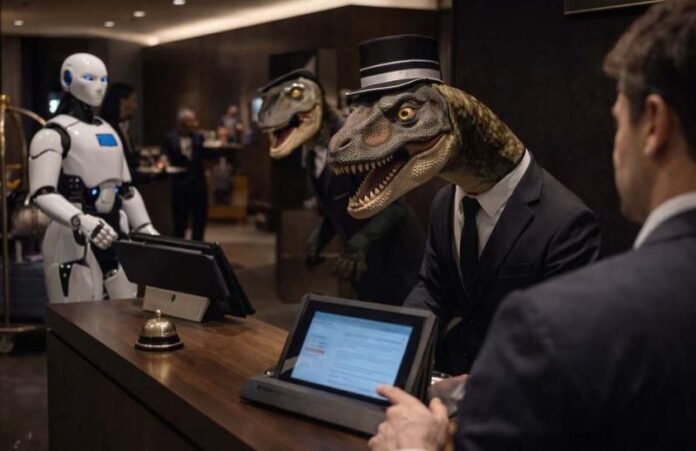
Tokyo. Can robots replace humans in the future? This question has been under discussion for a long time. Although time will tell what the future will hold, the present reality is that today millions of robots are active in the world. From factories to hotels, malls, restaurants and hospitals, automation is increasing rapidly.
About a decade ago, the world’s first ‘robot hotel’ was started in Japan. This hotel was like a glimpse of the future. Instead of humans, smiling dinosaur robots welcomed the guests at the reception. A faceless, pleasant voice explained the check-in process, and robotic porters carried guests’ luggage to their rooms. This unique experience caught the attention of tourists from all over the world and the hotel suddenly became the center of discussion. But this enthusiasm could not last long. Within a few months the limitations of the experiment began to emerge. The robots were proving to be more of a nuisance than an attraction for both hotel management and tourists.
The biggest problem emerged regarding customer experience. Robots could not understand different languages and accents properly. There were technical glitches in the transportation of goods and complaints of following wrong commands became common. The robots deployed at the reception were not able to resolve complex queries, changes in bookings or unexpected problems. Human intervention became necessary on every small and big problem. After this, it gradually became clear that robots can follow fixed instructions, but they cannot be equal to humans in terms of emotions, empathy and creative thinking. The failure of this experiment taught the world many important lessons regarding automation. The biggest lesson is that over-dependence on machines does not give better results in every field. Especially in the service sector, where human contact, sensitivity and problem-solving are most important.
Today, that experiment has been almost 10 years old. According to the International Federation of Robotics, there are about 4 million factory robots and 36 million service robots active in the world, whose number is increasing at the rate of about 10 percent every year. China, Japan, America, South Korea and Germany are at the forefront in this field.
Serving, delivery and reception robots are being used in malls, hotels and restaurants in many countries including India. However, experience has made it clear that robots can be assistants to humans, but not their complete substitute. The story of the world’s first robot hotel teaches us that as important as the speed of technology is, its sensible limits are equally important. The future of automation is bright, but the human role is still indispensable.

