

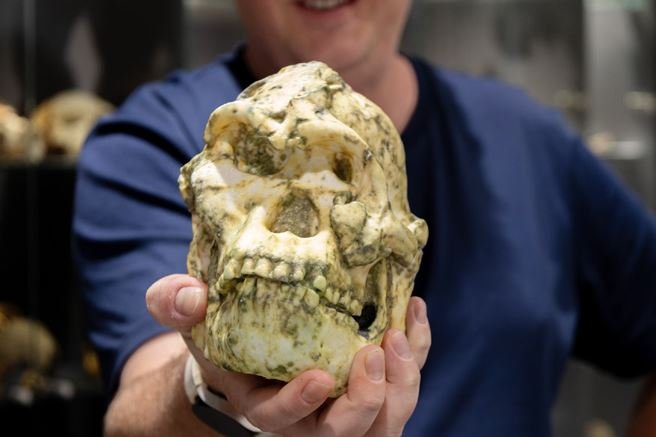
Melbourne/Johannesburg. An important discovery has come to light regarding the history of human development. Regarding ‘Little Foot’, considered one of the most complete hominin fossils in the world, scientists believe that it may be a hitherto unknown species of human ancestor. This study led by Australian researchers has sparked a new debate about the human evolutionary tree.
The ‘Little Foot’ skeleton was presented to the public in the year 2017. Its foot bones were found in 1994 in the Sterkfontein cave area of South Africa. After this, after excavation that continued for about 20 years, this almost complete skeleton came to light. It is considered the most complete Australopithecus skeleton ever discovered. Until now, there has been disagreement among scientists as to which species ‘Little Foot’ belongs to. Some experts considered it to be Australopithecus prometheus, while others said it was part of the species Australopithecus africanus, identified in 1925, fossils of which had previously been found in the same cave area.
However, in a new study published in the American Journal of Biological Anthropology, researchers have claimed that the physical appearance of ‘Little Foot’ is different from both known species. According to Dr. Jesse Martin, the study’s lead researcher, several structural differences, including the back of the skull, point to this being a new, as-yet-unsampled human ancestor species. Researchers believe this discovery could uncover a whole new branch of the human family tree. However, they have not formally named the new species and said that this task should be done by the team that has worked on this fossil for more than two decades.

