

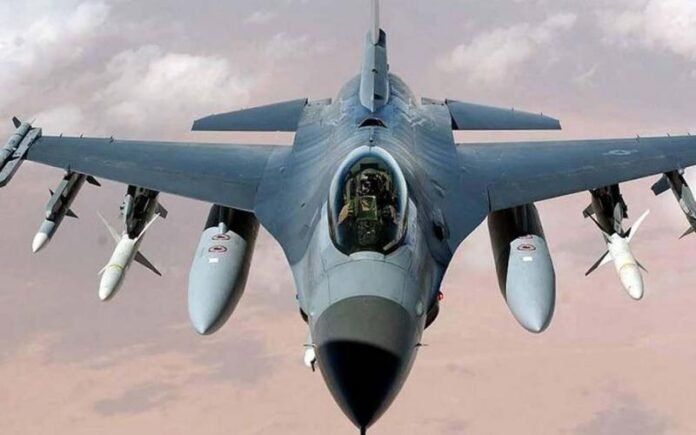
Washington. America has approved a package of $686 million to Pakistan for F-16 fighter planes. On the surface, this deal seems like increasing the strength of Pakistan’s Air Force, but if we look deeply, it is not a new capability, but an attempt to somehow keep the old aircraft flying by dragging them. Pakistan has not received a single new F-16 in this package. Neither any long-range lethal weapon, nor advanced air-to-air missiles nor electronic warfare systems.
America has clearly given only maintenance, repair and safety related items to Pakistan, so that these Cold War era jets somehow remain in service till 2040. The most important thing is that America has completely refused to provide the data link technology that Pakistan needed the most, Ling-22. Today, Ling-22 is considered to be a more modern, jam-proof and long-range working system than Ling-16. This technology is limited to selected NATO countries and high-end fighter jets.
In contrast, Pakistan has been given only Ling-16, which experts now consider to be old and limited capability technology. In modern warfare, while China, Russia and fifth generation fighter jets are working on advanced sensor fusion and high-speed networking, Ling-16 is a technology which can become weak in front of jamming and electronic attacks, that is, in simple words, America has not given cutting-edge technology to Pakistan, but a ‘second line’ system. With this deal, Pakistan’s F-16s will definitely keep flying for a few more years, but they cannot be called ready for the future high-tech war. In strategic circles, it is being considered as a junk deal for Pakistan in the name of F-16, in which there is a lot of show off and little real power.
America has drawn a very strict line in its defense relations with Pakistan. Pakistan will get the data link system along with the maintenance package of its F-16 fighter planes, but it will not be the state-of-the-art ‘Link 22’. America has made it clear that Pakistan will be given only the old but reliable ‘Link 16’. This decision reflects Washington’s approach in which it wants to keep Pakistan on board for anti-terrorism operations, but does not want to give it its best technology.
America has flatly refused to give Pakistan the technology which is reserved for its closest treaty allies. The specialty of Link 22 is that it is ‘jam-resistant’ and provides ‘Beyond Line of Sight’ networking capability i.e. the enemy cannot jam it easily and it can share data over very long distances. The US does not want Islamabad to have such a sensitive and state-of-the-art networking capability, so it will have to be satisfied with Link 16.

