

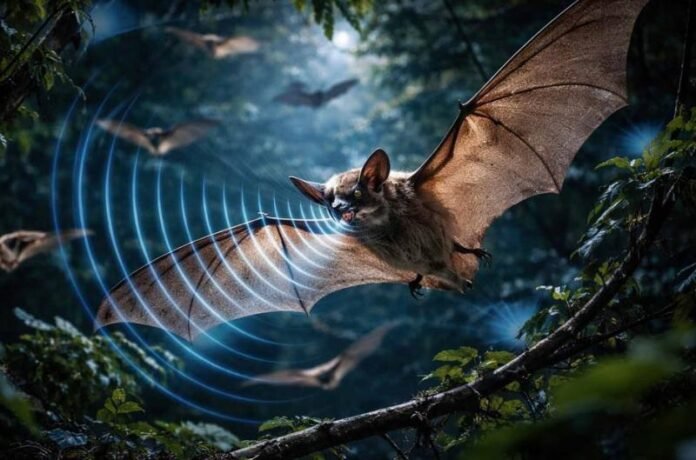
London . A long-standing question for scientists was how bats find their way so accurately in pitch-black darkness. Despite the dense forests, complete darkness all around and high-speed flight, bats never collide with trees, leaves or twigs. Scientists from Britain’s University of Bristol have unveiled this mystery. This discovery not only brings out the amazing potential of nature, but can also give new direction to future drone and robotic technology. Till now it was believed that bats fly entirely with the help of echo-location i.e. sound waves and map everything around them like sonar. But according to the new study, bats do not depend only on the echo of sound. They also sense the flow of sound and its speed, which scientists have named “acoustic flow velocity.” This means that bats do not measure the distance of each leaf or twig individually, but rather understand from the pattern of sound flow how dense the environment in front is and at what speed it would be safe to move forward.
To prove this theory, scientists conducted a special experiment, which was named “Bat Accelerator Machine”. It was a flight corridor about eight meters long, in which about 8,000 artificial leaves were planted to create an environment like a dense forest. In this experiment, the flight of more than 100 pipistrelle species of bats was closely tracked. Scientists moved these fake leaves back and forth, thereby changing the speed of flow of sound waves. When leaves were moved towards the bats and they felt the sound flow being stronger, they reduced their flight speed by about 28 percent.
At the same time, when the leaves were retracted and the sound flow seemed to slow down, the bats increased their speed. This made it clear that bats change their flight controls immediately by sensing the speed of the environment. Scientists say this process is based on the principle of Doppler shift, the same principle that causes the sound of sirens to change as an ambulance approaches and moves away. This means that bats are not just “seeing” by sound, but are also sensing movement and texture around them. This discovery is being considered a major achievement in the world of drones and robotics.

