

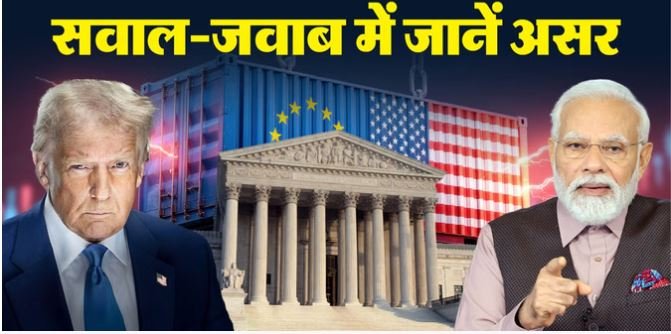
The US Supreme Court on Friday canceled President Donald Trump’s decision to impose tariffs on different countries. The court said that the powers used by the President to impose tariffs at the global level are beyond his jurisdiction. After this decision, Donald Trump government came on the back foot. However, Trump immediately used his emergency powers to once again impose a new 10 percent import duty on trade from all over the world. However, their decision will be applicable only on an interim basis and in the long run, the validity of the new tariffs will also expire.
Prime Minister of Bangladesh Tariq RahmanPremium
Politics of India and neighbourhood: What kind of Bangladesh does Rahman want to create, eyes will be on the new government. From Trump imposing tariffs on different countries to the Supreme Court declaring these import duties illegal and the US President once again announcing 10 percent tariff, a situation of confusion has arisen in the entire world including India. In fact, along with India, many countries of the world have either signed an interim trade agreement to reduce the impact of Trump’s tariffs or are waiting for its final approval. Under this, increased US tariffs were imposed on many countries. In such a situation, the question is whether the Supreme Court’s decision will end those interim agreements along with Trump’s tariffs. Let us know…
Question-1: What happened to Trump’s tariffs in the Supreme Court?
Question-2: What will happen after the decision of the Supreme Court?
This decision of the Supreme Court not only abolished the old tariff, but also opened the way for refund of the additional payments made by the importers on the products coming from abroad (about 130 billion to 175 billion dollars under the old tariff). However, this process can be quite complex and experts believe that it may take years. The court has now sent the case back to the US Court of International Trade (CIT) to resolve the refund claims. Experts say that earlier (after the 1998 decision) the process of giving refunds took about two years.
Question-3: How can those who bear the burden of import duty take refund?
News agency Reuters quoted legal experts as saying that each importer may have to file an individual lawsuit in the US Court of International Trade (CIT) to get a refund. It is currently unclear whether a class action suit will be possible in this case. Importers will have to submit accurate and detailed documentation to process the refund. Although the government has detailed records of import duty earned, the correct estimation of refund and routing it back to the accounts can create a huge confusion. Refunds can be given only to the entity who is considered the importer of record, i.e. the company which was responsible for paying customs duty and complying with the rules. If the tariff is paid through another company, who gets the money will depend on their mutual contracts.
Question-4: What did Trump do after the old tariffs were removed?
The Trump administration officially eliminated the old tariffs. The President issued a new executive order. Now other legal provisions like Section 122 of the Trade Act have been implemented and the new 10% tariff has been implemented. These new rates will be effective from February 24. Section 122 gives the US President the freedom to impose a maximum duty of 15 percent on imports from different countries for a maximum of 150 days. Under this rule, Trump is not obligated to take any administrative investigation or regulatory action to impose tariffs. However, after 150 days, these tariffs will no longer be in effect and only Parliament can extend their duration.
Question-5: How much tariff will be imposed on India now?
After the court’s decision, about 55 percent of Indian exports are now exempted from the 18% import duty and will attract 10 percent tariff. This rate is lower than the rate fixed under the India-US interim trade agreement. This has also been confirmed by Trump government officials. When a White House official was asked whether India would have to pay a 10% tariff, he said in the affirmative – Yes, 10% unless any other right applies.
Question-6: What do analysts and experts have to say on India’s tariffs?
According to experts, India will now be subject to only the standard Most-Favored Nation (MFN) tariff and a 10 percent tariff on top of that, which Trump imposed after the Supreme Court’s decision.
Question-7. Then why the confusion regarding tariffs on India?
The confusion regarding whether the tariff on India will be 10 percent or 18 percent emerged from a statement by President Trump. He said that nothing has changed in the trade agreement with India. He says India is paying the tariff, we have just made a small change. He stressed that the India deal is on and it will simply be implemented in a different legal way.
Question-8: Which areas of India do not get relief even after the removal of tariff?
Despite the US Supreme Court ruling declaring old tariffs illegal, many sectors and products have not received relief.
MFN will continue, relief for low value shipments ends
The new 10% global tariffs are in addition to the US’s existing ‘Most Favored Nation’ tariffs. For example, if a product already has a standard duty of five per cent, it will now have to pay a total duty of 15% (5% + 10%). Low value parcels (B2C), which were earlier duty-free, will no longer get relief. The administration has suspended the duty-free exemption on these and they too will now be subject to a new global tariff of 10%. Overall, Indian exports are now subject to a 10% tariff instead of 18%, but key industrial sectors like steel, aluminium, copper and auto parts have got no relief from the old high duties. Products like medicines and smartphones, which were already exempt, are likely to remain tariff-free going forward.
Question-9: What will happen to the rate fixed in the India-America trade agreement?
It is noteworthy that discussions are going on to implement the trade agreement between India and America. Earlier on February 6, both the countries had agreed on the framework of the trade agreement. That is, both the countries had decided how much import duty the two countries would impose on each other if the trade agreement was signed. Under this, India had agreed to zero tariff on most American products. On the other hand, America had agreed to reduce the tariff for different sectors from 50 percent (25 percent regular tariff + 25 percent penalty tariff for purchasing oil from Russia) to 18 percent. After this, a team of Indian officials is scheduled to meet their counterparts in Washington from February 23 to finalize the legal text of the agreement. According to Commerce Minister Piyush Goyal, this agreement is likely to be signed next month. After this it will come into effect by April. Since the terms of the trade agreement have not yet been signed by the officials of both the countries and have not been approved by the India-US Parliament, the trade deal is not in force between the two countries at present. However, there is a consensus on the tariff rates, on which experts are now advising India to compromise.
Question-10: What further steps does Trump consider regarding tariffs?
1. Order for investigation under section 301
After the Supreme Court’s decision, the Trump administration has announced to launch a new investigation into unfair trade practices under ‘Section 301’. Section 301 is a powerful provision of the US Trade Act of 1974 that the President uses to resolve trade disputes and prevent unfair trade practices that burden US commerce. According to news agency Associated Press, Trump can now target countries through these powers. The US Supreme Court has also just rendered ineffective those tariffs which were imposed under emergency powers. Tariffs already in place under Section 301 remain in full effect and are not affected by this legal change.
2. Why was this section not used earlier?
It is said that Trump had initially imposed tariffs using emergency powers, so that pressure could be put on different trading partners. However, now after the repeal of these tariffs, they can bring the countries that do not follow the interim agreement into the category of countries with unfair trade practices under Section 301. He has also ordered his administration to start a new investigation under this section. The process of investigation under Section 301 is quite lengthy. That’s why Trump did not use this section initially. According to experts and administration officials, these investigations could typically take a year or more to complete and lay a solid legal basis for implementing the new tariffs. However, these investigations provide a legal basis for imposing permanent and specific tariffs.
3. Which countries are now under investigation under Section 301?
Although the list of all the countries is not clear yet, the administration has indicated that investigations are already underway against China and Brazil, and other big trading partners like Vietnam-Canada may also come under its ambit in the future. Experts believe that after the Supreme Court’s decision, the rates fixed in the trade agreement between India and the US may be renegotiated. However, it will be a big challenge to protect the new trade agreement from the framework of laws like Section 301 or Section 232 (national security) in future.

