

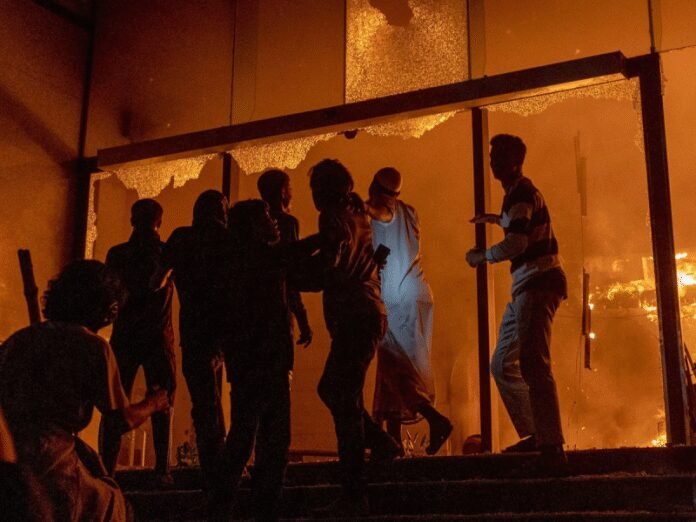
There is an uproar in Bangladesh after the death of student leader Sharif Usman Hadi. People have taken to the streets in the country. Slogans were raised. Arson was committed. The mob also attacked the media house. Late Friday night, a mob in Bangladesh simultaneously attacked the offices of The Daily Star and Prothom Alo in Dhaka. During this period, valuables were looted, buildings were vandalized and journalists were kept trapped inside for several hours. During this period, at least 150 computers and many important electronic equipment were stolen, while the canteens and files of the offices were also destroyed.
People’s anger erupted in Bangladesh after the death of student leader Hadi. Hadi was recently shot in the head. After this he was taken to Singapore for treatment. But, he could not be saved. On December 18, Mohammad Yunus, chief advisor to the interim government, announced Hadi’s death. There was an uproar in the country after he made this announcement. People’s anger also erupted on the media house.
havoc in the office
The protesters alleged that these newspapers were linked to spreading unrest and having political interests, although both the media organizations rejected these allegations outright. The attackers forcibly entered The Daily Star’s office at Kazi Nazrul Islam Avenue around midnight. They broke furniture and glass doors, destroyed computers, cameras and hard drives, tore down posters of Shaheed Abu Syed and Mir Mahfoozur Rahman Mugdho and set fire to several floors.
The situation became so bad that journalists had to go to the rooftop due to the flames and dense smoke. 28 journalists and staff had to take shelter on the rooftop for several hours. Investigative journalist Zaima Islam wrote on Facebook, I am unable to breathe now. There is too much smoke. I am trapped inside. you’re killing me. Fire fighters, police and army personnel rescued the trapped journalists at around 5 in the morning.
the newspaper was not published
This mob attack caused huge damage to the office and the supply of electricity, water and gas was cut off. The situation became so bad that The Daily Star could not print its newspaper for the first time in its 34-year history.
destroyed the building
Not only the Daily Star but Prothom Alo was also attacked. The attackers started the attack at Prothom Alo’s headquarters in Caravan Bazaar at around 11:15 pm. Initially the police stopped them, but the mob gathered again and attacked on a large scale. During this, office windows, furniture, computers, CCTV cameras, fire safety systems and cash lockers were broken. The area from the ground floor to the second floor was completely destroyed and the OTT platform Chorki of the building was also heavily damaged.
Journalists ran to the rooftop
The employees had to run away to save their lives. An employee jumped from the roof onto a nearby building, suffering serious injuries. For the first time in its 27-year history, the media house could not print its newspaper on Friday. Besides, online services also remained closed for about 17 hours.
Also, the protesters blocked the road due to which the fire services were delayed in reaching the place. Two firefighters, MD Alamgir and MD Shafiul Alam, were electrocuted and admitted to hospital. Later, police and army together evacuated the people safely. Violence was not limited to media institutions only. In Dhanmondi, the mob attacked Chhayanat Bhawan and vandalized musical instruments, artefacts and offices.
In which areas violence spread
The protests spread to Chittagong, Rajshahi, Uttara and other areas, where political and cultural institutions were targeted. Police detained 10 people after protesters threw stones at the Assistant Indian High Commission in Chittagong.
Interim Chief Advisor Prof. Muhammad Yunus, while talking to editors Matiur Rehman and Mahfooz Anam, expressed deep sorrow and assured cooperation from the government. Cultural Affairs Advisor Mostofa Sarwar Farooqui assured help in repairing the damaged institutions.
Political parties and media organizations, including the Editors Council, Committee to Protect Journalists (CPJ) and the Media Freedom Coalition, condemned the attacks. Local journalists and civic leaders tried to pacify the attackers, after which firefighters and police got a chance to control the fire.

