

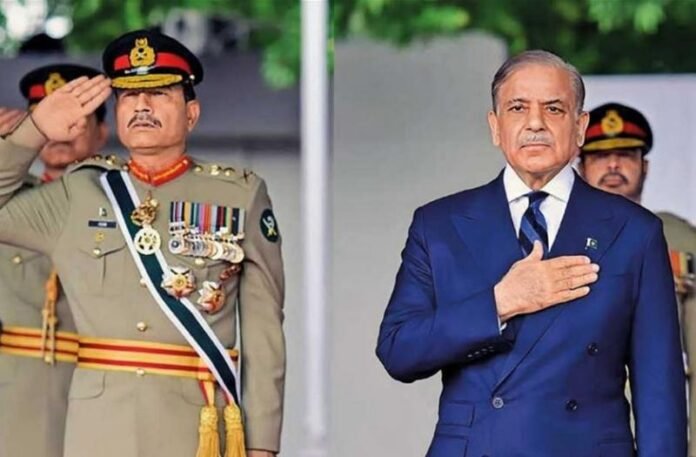

Islamabad. The long tussle, bargaining and power struggle in Pakistani politics finally ended in the direction that was discussed for a long time. Prime Minister Shehbaz Sharif finally bowed to the military’s dominance and gave his approval to the ‘super power’ appointment of General Asim Munir. By approving this proposal, President Asif Ali Zardari has also initiated a historic change in the power structure of Pakistan. Now questions are being raised that how did Shahbaz government bow down to Munir and what was the trick that Munir also became CDF.
Following the President’s approval, Field Marshal General Asim Munir will not only continue as the Chief of Army Staff (COAS) of Pakistan, but he will also become the country’s first Chief of Defense Forces (CDF). In this way, the command of all three armies of Pakistan i.e. Army, Navy and Air Force will now be in the hands of a single officer. This appointment has become possible after the 27th amendment to the Constitution of Pakistan, which has unprecedentedly increased the powers of the Army Chief.
The result of weeks of bargaining
The delay in signing this file was not merely technical. There was a period of tension and silence in the corridors of power of Islamabad for the last several weeks. According to sources, the delay was a result of intense ‘give and take’ talks between the Shehbaz government, Nawaz Sharif, his daughter Maryam Nawaz, and Army chief Asim Munir.
The PML-N leadership, especially Nawaz Sharif, wanted political security in return for this powerful appointment. Nawaz, who is seeing his dream of becoming Prime Minister for the fourth time coming true, wanted the Army not to stop his path in future. According to a senior PML-N source, if Munir wants to remain CDF and COAS for the next five years, he will have to ensure the return of Nawaz Sharif to power.
The government has no option left?
Sources say that Nawaz had set a condition that his opinion would be given importance in future army appointments also. Ultimately the Shahbaz government approved the proposal, indicating that either the Army had given all political assurances, or the government was left with no option but to accede.
attempt to arm the air force
Amidst the tense atmosphere, President Zardari also approved a two-year extension in the tenure of Air Chief Marshal Zaheer Ahmed Babar Sidhu. This is being seen as a strategy by Asim Munir to take all the forces together.
Deep impact on the future of Pakistan
The coming together of ranks like COAS, CDF and Field Marshal in the hands of Asim Munir points to unprecedented centralization of power in Pakistan. Experts say that this appointment further strengthens Pakistan’s ‘hybrid governance model’, in which the government is visible but the real power lies with the army. Giving this super power to Munir by Shahbaz government is an open admission of who is the real ‘kingmaker’ in Pakistan. The way Nawaz Sharif had to bow before the army to return to power has once again exposed the helplessness of Pakistan’s civilian government.

