

Dhaka. As the general elections approach in Bangladesh, anti-India rhetoric has intensified. Meanwhile, the statement of a leader of Bangladesh Nationalist Party (BNP) has created a new controversy. The BNP leader has pointed to India rather than the Pakistan Army for the massacre of Bengali intellectuals during the 1971 liberation war. This statement is not only being considered as tampering with historical facts, but it is also being linked to anti-India politics. It is being said that such leaders sympathize with Pakistan who are opposing India.
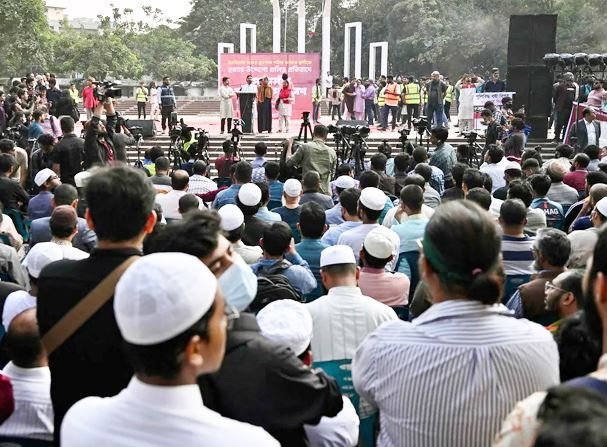
Advocate Abu Al Yusuf Khan Tipu, member secretary of Narayanganj city unit of BNP, said in a discussion program organized by the district administration on the occasion of Martyr Intellectuals Day on Sunday that the mass killing of Bengali intellectuals in 1971 was not done by the Pakistani army, but by the army of a neighboring country. His statement was considered to be indirectly pointing towards India. Tipu’s statement drew sharp criticism in political and social circles, following which BNP formally distanced itself from the statement.
It is noteworthy that this statement has come just a day before Vijay Diwas celebrated on 16th December. Victory Day is the day when the Pakistani Army surrendered in 1971 and Bangladesh became an independent nation. In India also it is celebrated as Vijay Diwas. This statement given on such a sensitive occasion has further heated the atmosphere. In his statement, Tipu also tried to acquit Jamaat-e-Islami of complicity in the atrocities of the West Pakistani Army and said that blaming any one political group was a distortion of history. He also urged the Jamaat to put pressure on the interim government to correct history. Earlier in the same program, Jamaat leader Ghulam Porwar had also claimed that the killing of intellectuals was a well-planned conspiracy by the Indian Army and its intelligence agency.
In this series, National Citizen Party (NCP) south region chief convenor Hasnat Abdullah also spewed sharp venom against India. He said in a threatening tone that if there is an attempt to destabilize Bangladesh, its impact will reach the north-eastern states of India. He made baseless allegations against India of border killings and interference in Bangladesh politics.
Political analysts believe that after the fall of Sheikh Hasina’s government and the new ruling dispensation, anti-India statements are becoming a part of the election strategy. Before the elections, an attempt is clearly being made to influence the public by raising the issue of nationalism and external enemies, which can also affect India-Bangladesh relations.

